Behind the Bottle: An Intimate Conversation with an Independent Perfumer
There is a particular kind of courage required to build a fragrance house from nothing. No corporate backing, no legacy name stitched into the label — only a vision, a palette of raw materials, and an unwavering belief that scent can say something the world has not yet heard. Independent perfumers embody that courage every time they uncap a formula.
For this feature, The Fragrance Way sat down with a niche perfumer working out of a small studio in the Pacific Northwest to discuss the creative process behind their work, the materials that move them most, and the philosophy that guides every fragrance they release.
Where Creativity Begins
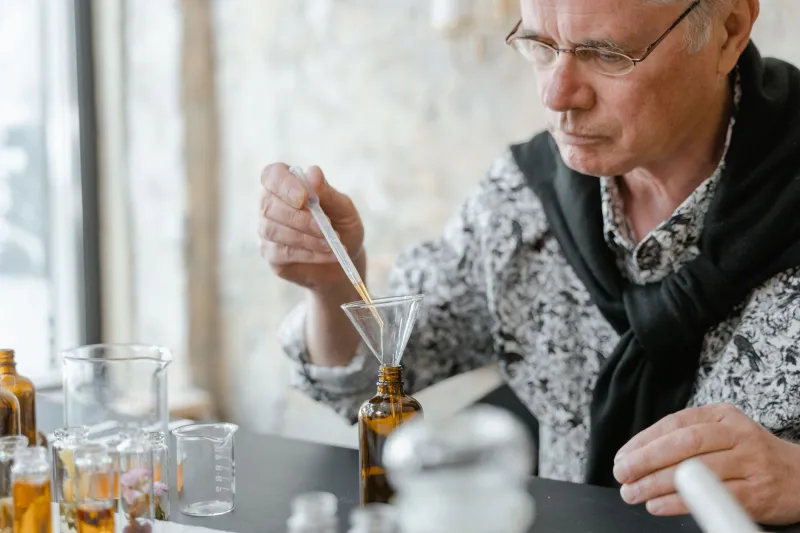
"I never start with a brief," they tell us, settling into a worn leather chair surrounded by amber vials and handwritten notebooks. "I start with a feeling I cannot name yet."
This approach — intuitive rather than formulaic — distinguishes many independent creators from their counterparts at large fragrance conglomerates, where market research and trend forecasting often precede the first drop of an accord. For independent perfumers, the origin point tends to be far more personal: a memory, a landscape, a texture, even a piece of music.
In this perfumer's case, the initial spark for their most celebrated fragrance — a dark, resinous composition built around aged oud, smoked birch, and a whisper of violet leaf — came from a childhood memory of their grandfather's workshop. "There was always sawdust in the air and something burning on the workbench. I wanted to bottle that specific kind of warmth."
The translation of memory into molecular language is one of the most demanding aspects of perfumery. Unlike a painter who can gesture toward an emotion with broad brushstrokes, a perfumer must coax feeling from a finite set of raw materials, each with its own volatility, character, and behavior on skin.
The Language of Raw Materials
Asking a perfumer about their favorite materials is not unlike asking a chef about their pantry essentials — the answer reveals everything about their aesthetic sensibility.
"I am obsessed with ambrette seed right now," they say without hesitation. "It has this musk quality that reads almost like skin, but with a slight nuttiness that keeps it interesting. It never lies flat."
Ambrette, derived from the seeds of the hibiscus plant, has become a favored alternative to animal-derived musks among independent perfumers who prioritize both ethical sourcing and olfactory complexity. It sits comfortably in the space between natural and synthetic, which suits a creator who refuses to align entirely with either camp.
"People in this industry sometimes treat the natural-versus-synthetic debate like a moral question," they note. "For me, it is purely about what serves the fragrance. Some of the most beautiful things I have ever smelled came from a laboratory."
This pragmatism extends to how they approach formula construction. Rather than working top-to-bottom through traditional fragrance pyramid logic, they tend to build outward from a central accord — what they call the "emotional core" — and layer supporting materials around it until the composition feels complete.
Crafting the Story Behind the Scent
For independent fragrance houses, narrative is not merely marketing — it is architecture. The story surrounding a scent shapes how a wearer experiences it, priming the senses before the first spray has even landed on skin.
"I spend almost as much time on the words as I do on the formula," the perfumer admits. "If the story is wrong, the fragrance feels wrong, even if the chemistry is perfect."
This attention to language is evident in the names and accompanying notes that accompany each release. One fragrance in their collection — a luminous, aldehydic floral with a salt-kissed base — is described simply as "the morning after a storm." No ingredient list. No elaborate mythology. Just six words that conjure a precise emotional weather.
"Americans respond to directness," they observe. "You do not need to dress everything up in ten layers of abstraction. Sometimes clarity is the most luxurious thing you can offer."
The Realities of Independent Creation
The romantic image of the solitary perfumer bent over their organ of scents does not tell the whole story. Running an independent house means wearing every hat: creative director, production manager, marketing strategist, and shipping department.
"There are weeks when I do not touch a single raw material because I am dealing with customs paperwork or updating the website," they say with a measured laugh. "You have to make peace with that, or it will break you."
Despite the operational weight, they remain firm in their decision to stay independent. The creative freedom, they argue, is simply irreplaceable. No formula has ever been shelved because a focus group found it too challenging. No accord has ever been diluted to meet a price-per-unit target.
"When someone writes to tell me that one of my fragrances smells like their late mother's garden, that is the entire point of what I do," they say quietly. "You cannot manufacture that with a committee."
What the Future Holds
Looking ahead, the perfumer is exploring a new collection built around American landscapes — the high desert of New Mexico, the bayous of Louisiana, the mineral cold of Lake Superior in January. It is an ambitious project, one that requires extensive travel and research before a single formula is sketched.
"Fragrance has always been dominated by European references — French perfumery, Italian citrus, Middle Eastern resins," they observe. "America has its own extraordinary olfactory geography. I want to map some of it."
For enthusiasts who have long sought scents that feel genuinely rooted in the American sensory experience, that ambition is nothing short of thrilling. And if the depth and intention behind their existing work is any indication, the results will be worth the wait.
The Fragrance Way will be following this collection's development closely. In the meantime, we encourage readers to explore the perfumer's current lineup — a body of work that demonstrates, with quiet authority, exactly what independent perfumery at its finest can achieve.